Finding Exeter
a market town without a market?
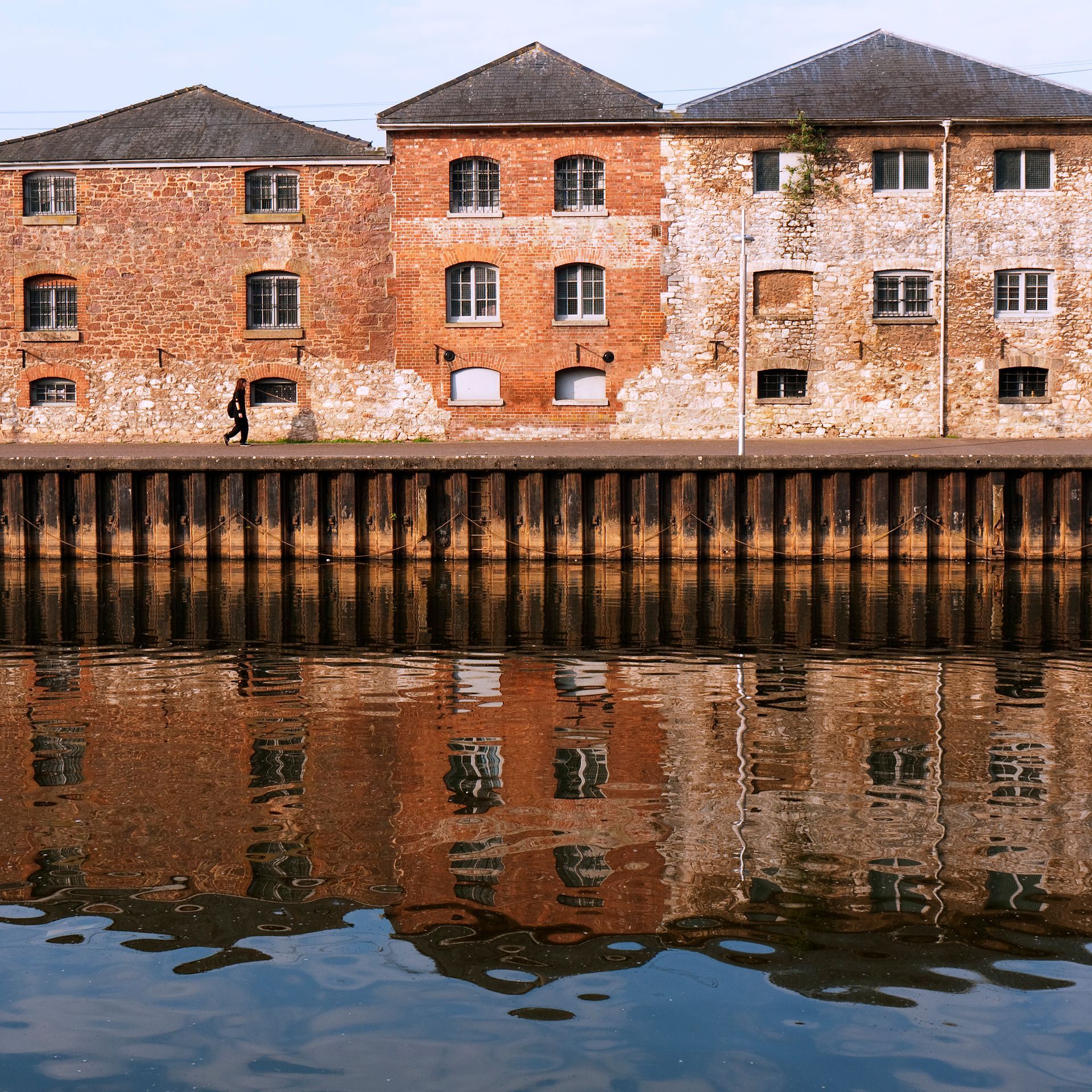
I've always thought of my home town this way; it operates on a human scale. It has the social density of somewhere smaller, but the infrastructure of somewhere larger. It certainly should have a proper market - but that’s another story.
It’s not quite a city despite the Cathedral. Not quite a village, but something in between; slightly self-contained, often underestimated by national news and its own residents. Exeter doesn’t shout; it persists. Persistence is unfashionable and is therefore a very particular kind of power.
Visitors come looking for charm…
Visitor’s Exeter
If you arrive fresh, Exeter feels almost improbably compact. You can walk everywhere. The Cathedral appears suddenly above the high street, as if it’s been waiting politely for you to notice it. The streets curve inwards on old desire lines. The quay opens outwards. Countryside presses close in visible fields, estuary light, the softer edges of Devon.
Exeter has charm. It’s not Bath’s honey-stone grandeur or Bristol’s energy. Exeter reveals itself in increments. A green space tucked behind an ancient wall. A quiet café in a Georgian terrace. A river path that leads you somewhere unexpectedly peaceful through long grasses.
Visitors see a picturesque city, they can feel history in the streets, they enjoy how easy it is - on the eye, on the senses, how much light touches the rooftops. They leave with the feeling that Exeter is…nice.
Which is true, and indeed nice. At my age, in this world, today and now - I’ll take nice. But what makes it so?
Resident’s Exeter
Living here is, of course, a different experience. Over time, you feel the layers: Roman foundations beneath your feet, Medieval trade routes mapped into street names and actual street patterns. The rebuilding after 1942, when much of the centre was flattened and the city got back up and carried on. The Cathedral at the visual and literal centre of it all.
That’s what I see, after my two decades here. Exeter carries on, resilient and shoulder-shrugging through cycles of global tension, annual rituals, weather events, politics. Schools cycle through years and generations. The university arrives each autumn and leaves each summer. The Home Counties stop by once a year ‘on the way to Cornwall’. Businesses open, close, similar ones reappear. You can cross the city on foot and run into three people you know. The pace is navigable.
This is why I call it a market town without a market; it’s steady, not loud.
For example, Exeter is the only UK city to hold UNESCO City of Literature status in 2026 - the ‘Year of Reading’. I was baffled as to why. I am a reader. I would never put Exeter top of my poll, so I asked the University why? The short answer is that the Cathedral quietly holds one of the great Anglo-Saxon manuscripts of poetry. Written in the late tenth century, it’s a window into everyday life at that time. Exeter does not advertise that fact. Consistency, not flamboyance, has given us this title. Likewise, the University attracts serious talent without needing to posture. The Quay worked as a port long before it was picturesque. There are family names here that you would have heard in the 15th and 16th centuries.
Exeter’s power is cumulative, not explosive. It doesn’t reinvent itself every decade, but accumulates layers. Roman, Medieval, Georgian, Victorian, Post-Blitz reconstruction.
The Risk of Understatement
Do I think Exeter underplays itself?
When a city is allergic to hype, as Exeter so obviously is, there is a danger that steadiness slips into invisibility. Visitors describe it as ‘nice’. Residents shrug at it, comparing it to Bristol or Bath. We know it works, but we don’t always articulate why. Endurance without a strong narrative is mistaken for inertia.
I realise that Exeter is quietly resilient, absorbing change, rebuilding rather than rebranding. It improves by accumulation. I cannot reinvent Exeter, but I can describe it better. I shall stop apologising for its scale and recognise its strength. Exeter isn’t a ‘nearly’ city; it’s a place that has survived, rebuilt, educated, traded, and rebooted for centuries without losing its footing in real life.
I’ve continued to build my life and my business here not because Exeter is loud, but because it is reliable. Because it allows you to create something thoughtfully, without being swallowed whole. Because it gives you room to work, to think, to host, all within walking distance of a Cathedral and its book of dirty Anglo-Saxon poems that has seen a thousand years pass and simply remained.
It doesn’t shout; it persists.